
TEMPLE
Stan Buglass
The bell is at once an instrument, an architectural feature, a machine for measuring communal time, and a device for announcing the movement of the individual through life. In ancient England, as today, the church bell calls its congregation together. It marked the working day, warned of imminent danger and solemnly announced death. The passing bell sounded before death, the death knell at the moment of death, and the lych bell accompanied the dead on their journey beyond mortality. The Old English word cnyllan describes the slow tolling of a bell. To hear the bell was to understand oneself as part of a larger social order: temporal, religious and geographical.
Temple takes up this old function of the bell at a moment when that order has become difficult to recognise.
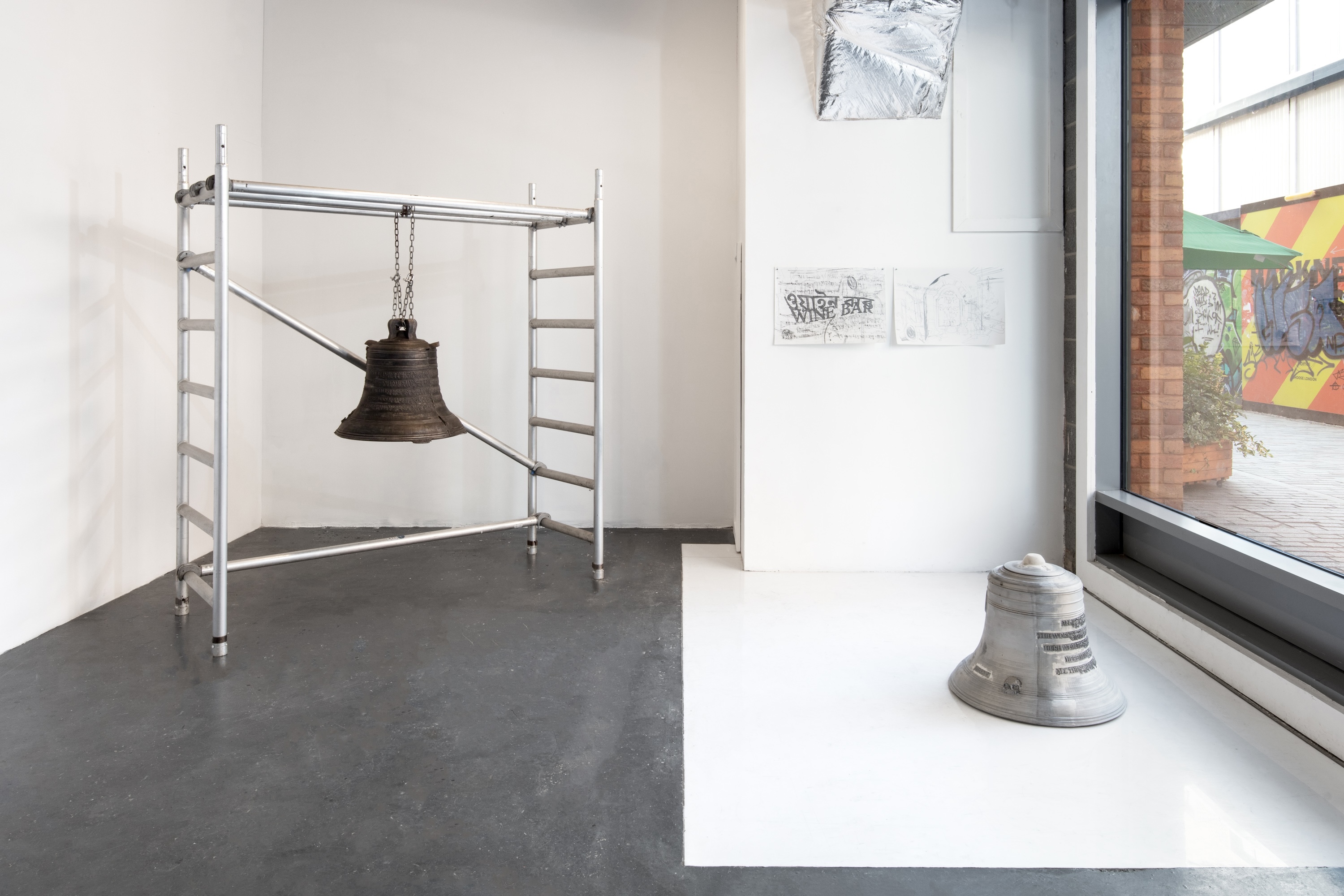
The bell at the centre of the exhibition carries an excerpt from The Wanderer, an Anglo-Saxon poem preserved in the Exeter Book. Its wandering speaker reflects upon the transience of earthly life: wealth, friendship, men and women all passing away, leaving the structures of the world empty. Or, as the romantic Percy Bysshe Shelley put it hundreds of years later, “Boundless and bare, the lone and level sands stretch far away.” The text appears in English alongside a Bengali rendering, bringing together two linguistic histories separated by more than a thousand years. What was once written in the language of early medieval England is encountered through a script associated with another part of the world, another history, another London.
This collision is particularly charged in East London, where language has long been a marker of locality and social class. To be “born within the sound of Bow Bells” is the traditional definition of a Cockney. Cockney was not simply a manner of pronunciation but a social geography, a means of locating the speaker within a particular urban world. Cockney rhyming slang could make language into a form of belonging, its meanings dependent upon shared knowledge and proximity. Against this intensely local language sits the increasingly international character of contemporary London, where English itself has become detached from any singular national or cultural ownership.
The history of English is, of course, a history of precisely this kind of transformation. Old English was itself produced through migration, conquest and linguistic contact. The language has continually absorbed and displaced other languages, changing as the people who speak it change. England, its English and the tacit Anglophone world cannot claim a stable inheritance, let alone a certain future.
The industrial landscape of East London presents a similar contradiction. Buglass reiterates his exploration of temporal artefacts in the accompanying sketches. The factories, warehouses, workshops and infrastructure that once gave the area its distinctive social character have been abandoned, repurposed or subsumed into a radically different urban economy. Of particular interest to the artist is the recently closed Whitechapel Bell Foundry, which for 250 years birthed some of the most famous bells in anglophone history, including the American Liberty Bell and the eponymous Big Ben. The foundry closed its doors for the last time in 2017 and is controversially being redeveloped by the Raycliff Whitechapel LLP into a ‘mixed-use boutique hotel and cultural space’. These physical remnants persist as fragments of a world whose social relations are increasingly difficult to recover. The distinction between ruin and redevelopment becomes difficult to maintain.
In this sense, Temple is concerned less with the simple disappearance of an English past than with the strange afterlife of its forms. The bell itself, cast deliberately in an inferior alloy to bronze, invokes the distant industrial processes of manufacture so distinctive to this part of London. It produces a less coherent sound than the bells it recalls. Its function is therefore not simply to reproduce an historical object, but to make something absent present through sound. To say that which cannot be said.
Temple may therefore be understood as a death knell. But for what? A place, a language, a class, a particular idea of Englishness? Or merely the fantasy that any of these things could remain unchanged?
Text by Adam Bellagha
For all enquiries, please email info@shipton.gallery